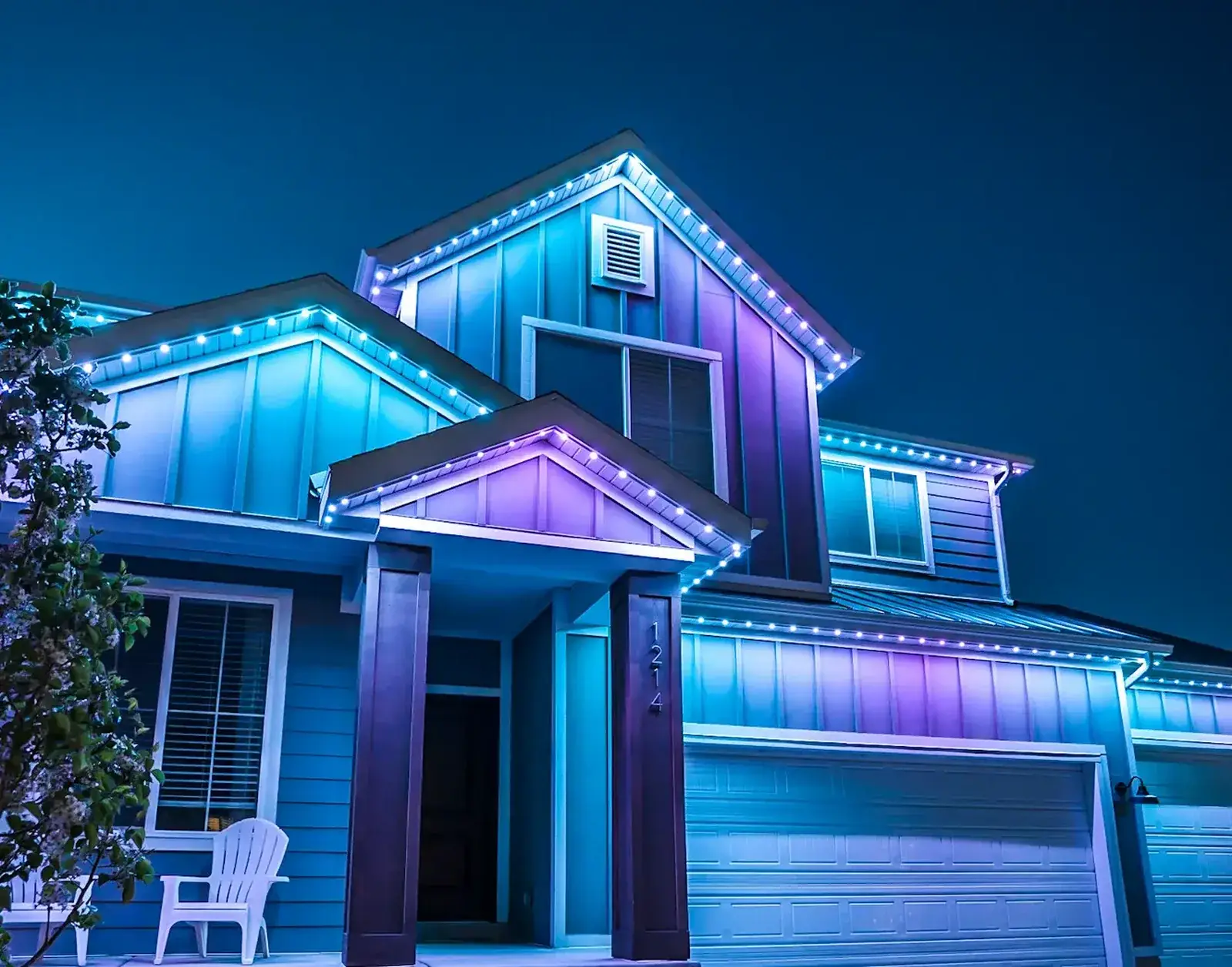
JellyFish Lighting Installation in Memphis
Permanent LED Lighting for Homes Across Memphis and Shelby County

Schedule Service!
Professional JellyFish Lighting in Memphis, TN
Permanent LED That Covers Holidays, Accent Lighting, and Security
JellyFish Lighting is a permanent LED system. It mounts in a slim track under your eaves and stays there. No hanging, no takedown, no bin in the garage labeled “lights, probably working.”
You run it from your phone.
Precision Pools & Landscape installs JellyFish across Memphis, Bartlett, Arlington, Germantown, Lakeland, and Collierville. We have worked on backyards here for over ten years. Most of that has been pools, pumps, and equipment pads. We already know what the back of your house looks like and where the power runs.
Here is the part people do not expect. Almost nobody ends up using this system mainly for Christmas. They buy it for December. Then they discover they run warm white on the rooflines four nights a week the rest of the year, because the house just looks better lit.
Thinking about permanent lighting? Get in touch and schedule your FREE outdoor lighting quote from Precision Pools & Landscape
Why JellyFish Lighting Works in Memphis, TN
Permanent lighting lives outside through everything this climate does. Roughly fifty four inches of rain a year, summer humidity in the seventies, a spring storm season, and the occasional ice event that drops power for days.
That is why the build quality and the install method matter more here than the brochure does. Here is what the system is, what it does, and what it costs.
What the System Actually Is
A run of individually addressable LEDs sits inside a slim aluminum track. The track mounts under the eave and behind the trim. It gets color matched to your fascia, so from the street in daylight most people do not notice it.
The lights themselves are where cheap permanent lighting falls apart. Some specifics from the manufacturer:
- UL and ETL certified, patented and manufactured in the USA. JellyFish has installed on homes since 2016 and lists over 50,000 homeowners.
- 16 gauge wire, chosen for weather resistance rather than cost.
- A four wire design. If one light fails, the rest of the run keeps working. On cheaper systems one failure can kill everything downstream.
- No individual connection points along the run. Connection points are where water gets in, and water getting in is how outdoor lighting dies.
- 16 million colors, including a real range of whites at 2700K, 3000K, 3500K, 4000K and 5000K.
- Under one watt per light at the brightest white, fully dimmable.
- Roughly 15 to 20 feet of vertical throw, behind a frosted lens. You see a smooth wash, not a row of dots.
Read the full spec sheet on the JellyFish Lighting product site. We install it, we do not build it. We would rather you check the wire gauge yourself than take our word for it.
One System Doing Three Jobs
The reason permanent lighting earns its cost is that it stops being one thing.
Holiday lighting. Red and green in December. Orange in October. Red, white and blue in July. Hundreds of preset patterns plus twenty movement effects, or build your own. That takes a minute on the app and no time on a ladder.
Everyday accent lighting. This is the one that surprises people. A warm white wash along the rooflines makes a house look considered rather than decorated. Most of our conversations end up being about which white, not which color.
Security lighting. Cool bright white on the back and side elevations does what a floodlight does, without the floodlight. The system integrates with Alexa, Google Home, Control4 and Nice-Elan. So you can trigger it from a camera event, and the back of the house comes up when something moves.
There is a fourth use we did not plan for. Gameday. Team colors on a Saturday in the fall is a small thing, and people love it.
It Is Not Only Rooflines
Most people come to us for the eave lighting. JellyFish makes three other lines, and they run on the same app and the same controller.
Patio Lights cover the outdoor living space. Pergolas, covered porches, the area you actually sit in. Same color range, same scheduling, no string lights sagging off a beam by August.
The Landscape Series works at ground level. Uplights at the base of trees, path lights along walkways, fixtures washing beds and the front elevation. We cover that on our landscape and pathway lighting page.
Pool cage and pool area lighting is the one that matters most to our existing customers. We are already at your pool every week. Lighting the deck and the water on the same system you use for the house is a short conversation, and the wiring is far easier while somebody is already working the equipment pad.
The practical advantage of adding lines later is that everything stays in one app with one set of zones and schedules. Bolt a different manufacturer’s landscape kit onto a JellyFish roofline and you are back to two apps and two timers.
The App Is Most of What You Are Buying
Anyone can sell you colored lights. What you are actually paying for is control. JellyFish builds its app and controller in-house rather than licensing someone else’s.
Zoning lets you treat sections separately. Front of the house on warm white for the evening. Back of the house dark until the dog goes out. Patio on something softer. On a long or L-shaped roofline, zoning is the difference between a system you use and one you switch on twice a year.
Schedules are where it stops needing you. Nightly, weekly, holiday and special event schedules save and repeat. Set dusk to eleven on warm white and you will forget the system is running. That is the goal.
Per-light control means you can dial in one gable rather than accepting whatever the whole run does.
We set all of this up before we leave. Zoning, your first schedules, and an app walkthrough happen on install day. Not in a follow-up call you have to chase.
What Memphis Weather Does to Outdoor Lighting
This is where a proper install separates from a fast one.
Permanent lighting almost never fails mid-run. It fails at connection points. It fails where water sits. That is why the four wire design and the connection-point-free run matter more here than they would in Phoenix.
It is also why we run wire through the attic with jumps instead of surface-mounting cable down an exterior wall. And why no power supplies hang outside the house.
Ask any installer where the wire runs and where the controller lives before you sign. If the answer involves conduit stapled to your siding, keep calling.
The tree canopy matters too. Germantown and Collierville have mature oaks and sweetgums that drop catkins, gumballs and pollen over everything. Track under the eave stays cleaner than ground fixtures. Still, the roofline needs walking before we quote. A limb resting on your fascia is a problem you want found in September, not January.
What It Costs and What Moves the Number
We quote every job on site. No number printed on a page will mean much for your specific house.
Published industry guides put professionally installed permanent roofline lighting between $2,500 and $6,000 for a typical home, usually priced per linear foot. Treat that as a category sanity check. It is not our price.
What actually moves your number:
- Linear footage of roofline. The single biggest factor. Two houses of identical square footage can quote very differently depending on how much roofline you want lit.
- Roofline complexity. Dormers, multiple gables, and several roof planes take longer than one clean run across a ranch.
- Height and access. A two story with a walkout basement means more equipment and more time.
- Track color matching to your fascia. Standard, but it affects lead time.
- Add-ons like patio lighting, pool area lighting, or tying controls into a system you already run.
A single story with one clean front run is not the same job as a two story with four gables. The estimate is free. The site visit is short. You get a number, not a range.
Is It Actually Worth It?
Depends on one question. Do you currently pay someone to hang Christmas lights?
If you do, the math is simple. That yearly cost disappears and does not come back. The system pays itself off over a handful of seasons, then keeps going. If you have been climbing the ladder yourself, the payoff is not financial. You just stop climbing the ladder.
Never hung lights and never planned to? Then be honest about what you are buying. You are buying accent and security lighting that also does holidays. Judge it on that, because that is what you will use eleven months a year.
What we will not tell you is that it adds real resale value. The National Association of Realtors’ 2023 Remodeling Impact Report puts landscape lighting at roughly 59 percent cost recovery at resale. That is one of the lower returns among outdoor projects, though it scores high on their homeowner Joy Score.
You will find pages claiming outdoor lighting makes a home worth up to 20 percent more. That figure has no source behind it. Buy this because you want to look at your house after dark.
The HOA Question in Germantown and Collierville
This comes up on nearly every quote. Here is the useful answer instead of “check with your HOA.”
The holiday decoration clause in your CC&Rs is probably not the rule that governs a permanent system. Those clauses generally cover temporary decor, with the familiar thirty-days-before and down-by-January language.
A hardwired permanent system usually falls under architectural control instead. Many associations require approval for anything hardwired or spanning more than 25 linear feet.
Where boards approve it, the common condition is that everyday use stays on static warm white, with color saved for holidays. Most people run it that way anyway.
Submit the color matched track detail with your application. The fact that the track disappears against the fascia in daylight is usually what gets it approved. JellyFish publishes HOA-specific material you can attach.
Get approval in writing before we install. Not because we expect trouble, but because “the board said it was fine” is worth very little in March when the board has three new members.
What Installation Day Looks Like
Most single family installs are a one day job. Larger or more complex rooflines can run into a second day.
The order is straightforward. We measure and confirm the run. We mount track color matched to your fascia. Wire goes through the attic with jumps, so nothing is surface mounted outside. The controller and power supply go somewhere protected. Then we commission the system.
Commissioning is the part people forget to ask about. Zoning, your first schedules, and an app walkthrough all happen before the crew leaves. You should be able to change a color and set a timer yourself that same evening.
We are also who comes back. If a section drops out in February, you call the number you already have for your pool service. Not a regional office three states away.
Why Use the Company Already in Your Backyard
We are on the property anyway.
That sounds minor and it is not. We already know where your equipment pad sits, how your power is run, and what your yard does in August. When lighting controls and your pool automation live in the same place, that is one system to learn instead of two. It is also one number to call when something stops responding.
We have been in the trade over ten years across two counties. We look after more than a hundred properties a year, and we hold a 4.9 star rating on Google. Family owned. The crew that shows up for this is the crew you already know.
We will also tell you when a job is not worth doing. Want two spotlights on a flagpole? Buy them at a big box store and put them in yourself. Call us when the run is long enough or high enough that doing it right matters.
Schedule Your JellyFish Lighting Install
We install JellyFish Lighting across Memphis and the surrounding Shelby County communities within about a fifteen mile radius. That includes Bartlett, Arlington, Germantown, Lakeland, and Collierville. Just outside that? Call and ask. The answer is usually yes.
Demand climbs hard from September through November. The calendar fills in the order people call. If you want it running before the holidays, now beats October.
Call (901) 599-2225 or request a free quote and we will come look at the roofline.
Our Service Areas
Common Questions About JellyFish Lighting
The questions homeowners actually ask us, answered straight. If yours is not here, call and ask.
JellyFish Lighting is a permanent LED system installed in a slim track under your eaves. It stays up year round and runs from a phone app. One system covers holiday lighting, everyday warm white accent lighting, and bright white security lighting. The lights are individually addressable with 16 million colors. The track is color matched to your fascia, so it stays discreet in daylight.
We quote every job on site. Roofline length and complexity drive the number more than house size does. Published industry guides put installed permanent roofline lighting between $2,500 and $6,000 for a typical home, usually priced per linear foot. Use that as a category check, not as our price. A single story with one clean front run is a different job from a two story with four gables.
Barely, when it is installed properly. The track is color matched to your fascia and mounted under the eave. From the street in daylight, most people do not notice it. The giveaway on a bad install is never the track. It is the wiring. Exposed power supplies, surface run cable, and connections left outside the house are what people actually see.
Yes. It integrates with Amazon Alexa, Google Home, Control4, and Nice-Elan. That gives you voice control. It also means other smart home events can trigger the lights, so a camera detecting motion can bring the back of the house up to bright white.
Not meaningfully. Each light draws under one watt at its brightest white setting, and the system is fully dimmable. The U.S. Department of Energy puts quality LED lighting at at least 75 percent less energy than incandescent, with up to 25 times the lifespan. A full roofline running nightly costs about what a couple of household bulbs do.
Yes. The lights throw roughly 15 to 20 feet vertically and run up to 5000K cool white. That is a very different tool from the warm 2700K you would use for accent lighting. Zoning matters here. Leave the front on warm white for the evening and put only the back and side elevations on bright white.
The rest of the run keeps working. JellyFish uses a four wire design so one failure does not take down everything downstream. The run also has no individual connection points along its length. That is where water usually gets into cheaper systems.
Most single family installs are a one day job. Larger or more complex rooflines can run into a second day. The part worth asking any installer about is commissioning. Zoning, your first schedules, and an app walkthrough should happen before the crew leaves, not in a follow-up call.
Usually, but get written approval first. The holiday decoration clause in your CC&Rs likely governs only temporary decor. A hardwired permanent system typically falls under architectural control instead. Many associations require approval for anything hardwired or spanning more than 25 linear feet. Where boards approve, a common condition is that everyday use stays on static warm white.
We install across Memphis and surrounding Shelby County communities within about a fifteen mile radius. That includes Bartlett, Arlington, Germantown, Lakeland, and Collierville. Precision Pools & Landscape has worked on properties across this area for over ten years. Just outside that radius? Call (901) 599-2225 and ask.
Still have questions?