
Landscape Lighting Installation in Memphis
Tree Uplighting, Pathway and Garden Lighting for Homes Across Shelby County

Schedule Service!
Professional Landscape Lighting in Memphis, TN
Uplighting, Path Lighting, and Garden Lighting That Works After Dark
Landscape lighting is the ground level half of a lit property. Uplights at the base of trees. Path lights along walkways. Fixtures washing garden beds and the front of the house.
It is also the cheapest dramatic change you can make to a Memphis front yard.
Precision Pools & Landscape installs landscape lighting across Memphis, Bartlett, Arlington, Germantown, Lakeland, and Collierville. We have worked on properties here for over ten years, mostly around pools and equipment, so we already know these yards and what the soil does when you dig in it.
Most people call about the trees. They stay for the walkway, because that is the part they use every night.
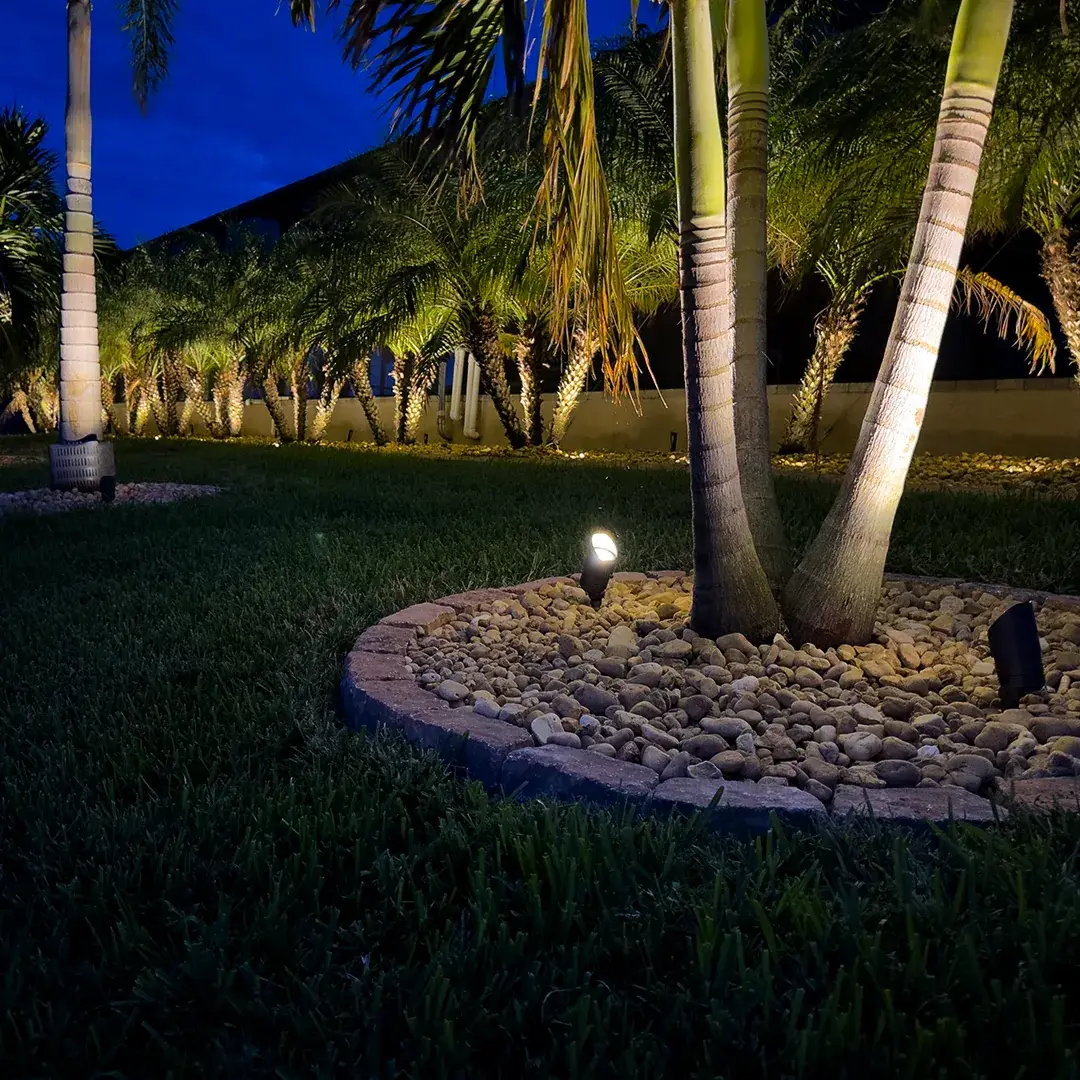
Want your yard lit properly? Get in touch and schedule your FREE landscape lighting quote from Precision Pools & Landscape
Why Landscape Lighting Works So Well in Memphis, TN
Memphis has the trees for this, and that is not true everywhere. It also has fifty four inches of rain a year, a spring storm season, and a fall that buries anything sitting low in a bed.
Both of those facts shape the design. Here is how we approach a yard here, what the techniques actually are, and what it costs.
The Tree Canopy Is the Whole Argument
Germantown and Collierville sit on mature lots with willow oaks, water oaks, sweetgums and pines that have had decades to fill out. A big oak uplit from two sides at the base does more for a front elevation after dark than another round of shrubs ever will.
The technique matters more than the fixture count. Two well aimed uplights on one specimen tree beat eight lights scattered across the yard. What you are lighting is the trunk and the underside of the canopy, so the tree reads as a shape rather than a silhouette.
Newer subdivisions in Arlington and Lakeland are a different job. Younger trees mean less to uplight, so those yards usually get more out of path lighting, bed washing, and grazing light across brick or stone on the house itself.
We will tell you which one your yard is. Sometimes the honest answer is that your trees need five more years and your walkway needs lighting now.
What We Actually Install
- Tree uplighting. Fixtures at the base, aimed up through the canopy. Warm color temperature, usually 2700K, because cool white on bark looks like a parking lot.
- Path lighting. Along walkways, driveways, and the run between the back door and the pool deck. Spaced so the pools of light overlap slightly. Nobody wants a runway.
- Bed and garden lighting. Low fixtures washing planting beds, which gives depth to the front of the house instead of a flat wall of brick.
- Wall grazing and facade lighting. Light aimed close and parallel to a textured surface. On stone or brick it picks up every shadow, and it is the most underused technique in residential lighting.
- Step and hardscape lighting. Recessed into risers, retaining walls, and seating areas. This is the safety half of the job.
- Pool deck and water feature lighting. We are already at your pool. Lighting the deck, the coping and the surrounding beds while somebody is on site is the easiest add we do.
Downlighting, and Why Nobody Asks for It by Name
Almost every homeowner asks for uplighting. Very few know to ask for the opposite.
Downlighting means mounting fixtures up in the tree and aiming them down through the branches. The light filters through the canopy and lands dappled on the lawn and the walkway below. In the trade it gets called moonlighting, and that is exactly what it looks like.
It is the single best use of a mature Memphis oak, and hardly anyone here has it.
Uplighting makes the tree the object. Downlighting uses the tree as the fixture, lighting the space underneath it. On a big canopy over a driveway or a seating area, that is far more useful than another spotlight on the trunk.
The catch is access. Somebody has to get up the tree, mount the fixture properly, and run the wire down without girdling anything. It costs more than an uplight and it takes longer. It also lasts, because a fixture eight feet up never gets buried in leaf litter or clipped by a string trimmer.
The other techniques worth knowing by name:
- Grazing. Light aimed close and parallel to a textured wall. On stone or old brick it throws every shadow into relief.
- Washing. Light aimed from further back for even, flat coverage. Right for smooth surfaces, wrong for texture.
- Silhouetting. Light behind a plant, aimed at the wall behind it. The plant goes dark against a lit surface. Works beautifully on Japanese maples and ornamental grasses.
- Shadowing. Light in front and low, throwing the plant’s shadow onto the wall behind. Moves with the wind, which is either charming or annoying depending on the person.
You do not need to know any of this to hire us. But if an installer cannot explain which of these he is proposing and why, that tells you something.
What Actually Happens on the Quote Visit
We come out after dark. That is not a scheduling preference, it is the only time the design decisions are visible.
In daylight you are guessing. You cannot see where the ambient light already falls, where the street light spills into the yard, which trees have a shape worth lighting, or where the dark spots that actually bother you are. Thirty minutes in the dark answers all of it.
We walk the property with you and ask what bothers you at night. Usually it is one specific thing. A dark stretch of walkway. The blank front elevation. Or a patio nobody uses after nine.
Then we look at the trees honestly. Some are worth lighting and some are not. A young tree with a thin canopy will not reward an uplight for another few years, and we would rather say so than sell you two fixtures that underwhelm.
We check the practical constraints. Where the irrigation zones run. How the power gets out there. Which beds fill with leaf litter in the fall. Whether trenching has to cross hardscape, and what that adds.
Then you get a number. Not a range, and not a per-fixture rate multiplied out on a clipboard.
One more thing worth saying. We aim the fixtures after dark on install day, not during the afternoon. A light aimed in daylight is a guess, and it is the difference between a system that looks designed and one that looks installed.
The Part Nobody Tells You: Fixtures Get Buried
This is the Memphis specific problem, and no competitor page mentions it.
That same canopy that makes uplighting worth doing also drops sweetgum balls, oak catkins, acorns and pine needles across every bed in the yard. By November a fixture set too low in a bed is under two inches of leaf litter, throwing light into mulch.
So placement is not just about the beam. It is about where debris collects, where your crew blows leaves, and where mulch gets topped up every spring. We set fixtures proud of the bed line and angle them so a season of litter does not swallow them.
The same goes for irrigation. Heads and lighting fixtures compete for the same real estate, and we would rather find your zones before we trench than after.
Memphis Weather and Why the Wiring Matters More Than the Fixture
Anything buried here lives through roughly fifty four inches of rain a year, summer humidity in the seventies, and a spring storm season that saturates the ground for days.
Landscape lighting almost never fails in the middle of a run. It fails at the connections, and it fails where water sits.
What separates a system you forget from one you chase every March:
- Burial rated connections, not twist caps pushed into a bed and hoped for
- Correct wire gauge for the run length, because voltage drop over a long run dims the far end
- Sealed, UL or ETL listed fixtures, with the transformer mounted at least a foot off the ground and out of direct weather
- Brass or copper over aluminum on anything that sits in wet mulch, because aluminum in Memphis beds pits and fails early
Ask any installer what happens to the run when one fixture floods. If the answer is a shrug, keep calling.
Sizing the System Properly
Most homeowners are surprised by how much of this is arithmetic rather than taste.
Total up your fixture wattage, then size the transformer so that load sits near 80 percent of its rating. That leaves headroom and room to add fixtures later without replacing the transformer.
Modern LED landscape fixtures typically draw 2 to 10 watts each. Older halogen ran 20 to 50 watts for the same light. So a system designed today runs far more fixtures on the same transformer than one designed fifteen years ago, and if you are replacing an old halogen system you can usually add considerably to it.
A worked example: twelve path lights at 4 watts plus six tree uplights at 7 watts totals 90 watts. That points to a 120 watt transformer, not a 100.
Run length matters just as much. A long run on undersized wire will dim the fixtures at the far end, and that shows up as a system that looks fine near the house and tired at the property line.
What Landscape Lighting Costs
We quote on site, because fixture count is only half the number. The other half is how hard your yard is to dig.
What moves it:
- Fixture count and type. Uplights, path lights, and hardscape fixtures are different costs.
- Trenching distance and difficulty. Open turf is straightforward. Established beds, tree roots, hardscape and driveways are not.
- Transformer sizing, and whether you need more than one for the layout.
- Wire gauge and run lengths, which are set by the design rather than chosen for price.
- Fixture material. Brass costs more than aluminum up front and outlasts it in wet Memphis beds.
- Controls, if you want the system on a timer, a photocell, or tied into something you already run.
Two houses on the same street land in very different places if one has open lawn and the other has forty feet of established bed and a stamped concrete walkway to cross.
What It Is Actually Worth
Landscape lighting will change how your property feels at night more than almost anything else you can spend the same money on. What it will not do is return that money at resale, and you should hear that from us rather than find out later.
The National Association of Realtors’ 2023 Remodeling Impact Report puts landscape lighting at roughly 59 percent cost recovery at resale. That is one of the lower returns among outdoor projects. It also scores high on their homeowner Joy Score, which is the honest reason to do it.
You will find pages claiming outdoor lighting makes a home worth up to 20 percent more. That figure has no source behind it anywhere we can find. Buy landscape lighting because you want to use and look at your yard after dark. Treat any resale bump as a bonus.
Running cost is not a concern either. The U.S. Department of Energy puts quality LED lighting at at least 75 percent less energy than incandescent, with up to 25 times the lifespan. A full landscape system on a timer costs very little to run nightly.
Light Less Than You Think
An opinion that costs us work sometimes.
Most residential landscape lighting is overdone. Too many fixtures, too bright, too cool in color temperature, and aimed so they throw light into the street and the neighbour’s bedroom. The result reads as a car dealership rather than a home.
Restraint looks more expensive. Fewer fixtures, warmer color, shielded so you see the effect rather than the source, and dark space left between the lit areas so the lit parts mean something. DarkSky International publishes good, plain guidance on shielding and warm color temperature that is worth ten minutes of your time before you decide on a design.
If you tell us you want the whole yard lit, we will build it. We will also tell you first that you probably want about half of it.
Schedule Your Landscape Lighting Install
We install landscape lighting across Memphis and the surrounding Shelby County communities within about a fifteen mile radius, including Bartlett, Arlington, Germantown, Lakeland, and Collierville. Just outside that? Call and ask.
Also worth knowing: if you are considering roofline lighting too, doing both at once saves a second mobilisation and keeps everything on one control system. Our permanent LED roofline lighting page covers that side.
Call (901) 599-2225 or request a free quote and we will walk the yard with you after dark, which is the only time you can actually see what the design needs to do.
Our Service Areas
Common Questions About Landscape Lighting
The questions homeowners actually ask us, answered straight. If yours is not here, call and ask.
We quote on site, because trenching difficulty affects the number as much as fixture count does. A yard of open turf and a yard with forty feet of established bed and a stamped concrete walkway are different jobs at the same fixture count. What moves the price: number and type of fixtures, trenching distance, transformer sizing, wire gauge and run length, and whether you want brass or aluminum. The estimate is free and we walk the property with you.
Size the transformer so total fixture wattage sits near 80 percent of its rating. That leaves headroom and room to expand. LED landscape fixtures typically draw 2 to 10 watts each, against 20 to 50 watts for older halogen, so a modern system runs far more fixtures on the same transformer. Twelve path lights at 4 watts plus six uplights at 7 watts totals 90 watts, which points to a 120 watt transformer rather than a 100.
Warm, usually 2700K, especially on trees and anything natural. Cool white on bark and mulch looks industrial and flattens the texture you are trying to show. Some designers push 3000K on stone and brick facades where a slightly crisper light picks up more detail. What you want to avoid is mixing temperatures across one yard, because the inconsistency is obvious at night even to people who cannot name what is wrong.
It adds enjoyment far more reliably than resale value. The National Association of Realtors' 2023 Remodeling Impact Report puts landscape lighting at roughly 59 percent cost recovery at resale, one of the lower returns among outdoor projects, while scoring high on their homeowner Joy Score. Pages claiming outdoor lighting makes a home worth up to 20 percent more do not cite a source for it. Buy it because you want to use your yard after dark.
Very little. The U.S. Department of Energy puts quality LED lighting at at least 75 percent less energy than incandescent with up to 25 times the lifespan. A full residential landscape system running nightly on a timer adds a small amount to a Memphis power bill. Halogen systems were a different story, which is one reason replacing an old system usually pays for part of itself.
They do when the wiring is right, and they fail when it is not. Memphis gets roughly 54 inches of rain a year plus a spring storm season that keeps ground saturated for days. Fixtures rarely fail mid-run. They fail at connections and anywhere water is allowed to sit. Burial rated connections, correct wire gauge, sealed UL or ETL listed fixtures, and a transformer mounted off the ground are what separate a system you forget from one you chase every March.
They will if the fixtures are set too low, and this is a genuine Memphis problem. Sweetgum balls, oak catkins, acorns and pine needles fill beds fast in the fall. A fixture sitting flush in a bed can be under two inches of litter by November, lighting nothing but mulch. We set fixtures proud of the bed line and place them accounting for where debris collects and where mulch gets topped up each spring.
Yes, and it is the easiest add we do for existing customers. We are already on the property for pool service, so we know where the equipment pad is and how power is run. Lighting the pool deck, coping, and surrounding beds while somebody is already on site avoids a separate mobilisation. It can also run on the same controls as roofline lighting if you have both.
Most residential systems are one day, sometimes two. Fixture count matters less than trenching does. Open turf is fast. Established beds, tree roots, hardscape, driveways and irrigation zones all slow it down. Ask about aiming, too. Fixtures should be aimed after dark on the day of install, because a light aimed in daylight is a guess.
We serve Memphis and the surrounding Shelby County communities within about a fifteen mile radius, including Bartlett, Arlington, Germantown, Lakeland, and Collierville. Precision Pools & Landscape has worked on properties across this area for over ten years. If you are just outside that radius, call (901) 599-2225 and ask. The answer is usually yes.